

Vanishing Cairo on the Removal of Historic and Popular Landscapes
Vanishing Cairo was a one-day seminar held on 8 May 2025 at CEDEJ, Cairo, exploring the erasure of historic and popular urban landscapes. Bureau Gladys presented their Fustat research, alongside discussions on urban development, displacement, and heritage loss in contemporary Cairo.
8th of May 2025
CEDEJ, Cairo, Egypt
Seminar
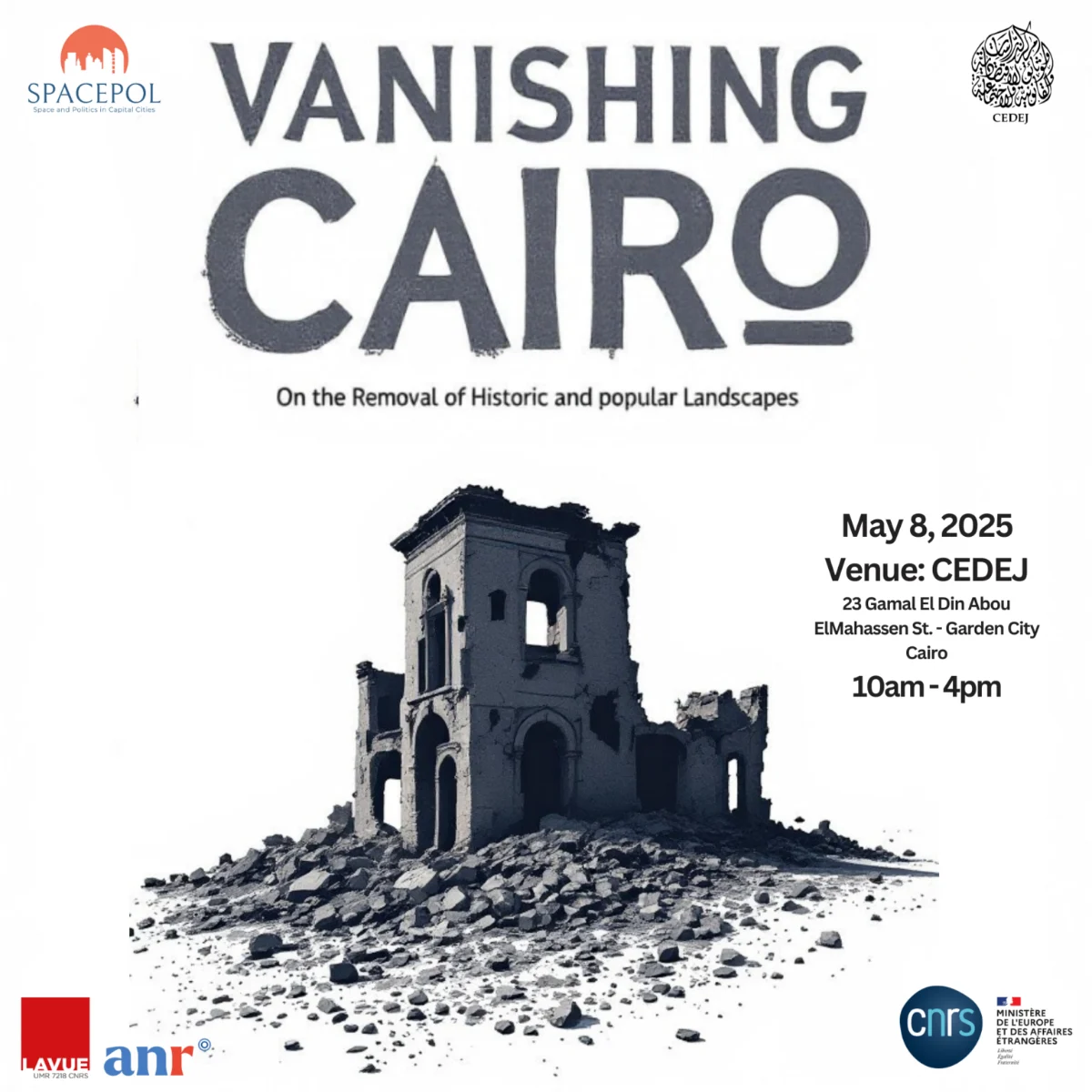
About the event
This one day seminar was put together by Agnès Deboulet In collaboration with Spacepol, Lavue, ANR, CEDEJ. The event brought together a range of scholars and practitioners to critically interrogate the ongoing erasure of Cairo’s historical and popular urban landscapes under the guise of development, where Bureau Gladys team presented their project “Fustat : from capital city to real estate capital”.
https://oui.hypotheses.org/9097
The Vanishing Cairo seminar was held at CEDEJ (Centre d’études et de documentation économiques, juridiques et sociales). Opening remarks by CEDEJ Director Frédéric Lagrange and an introduction to the SpacePol programme by Agnès Deboulet framed the discussion around spatial politics and state-led transformations. Ingy Higazy examined the Greater Cairo Ring Road as a symbol of mobility-led development that simultaneously destroys established communities. Dalia Wahdan and Yomna el Gendy traced the metamorphosis of Fustat from an early Islamic capital into a terrain of aggressive real estate speculation, while Yahia Shawkat offered a scathing critique of state expropriation policies, highlighting the financial logic that underpins displacement. A collective intervention by Ahmed Zaazaa, Salma Belal, and Agnès Deboulet contextualised Cairo’s urban frenzy as a capital-centric drive, rooted in spatial gigantism and dispossession, developed further in a forthcoming SpacePol publication. Zaazaa’s subsequent presentation introduced his “New Maps of Cairo,” a critical documentation of transformations between 2015 and 2025, mapping out the violence of invisibilisation. The seminar closed with Ahmed Mansour’s poignant reflection on heritage loss in Historic Cairo, showing how legal protections are routinely bypassed to facilitate demolition. Altogether, the day laid bare the extractive, speculative, and performative logics behind Cairo’s contemporary urbanism, and provided urgent tools to make visible what is being systematically made to disappear.